
How to Rank #1 on Google for Your Dental Practice
The complete dental SEO playbook for local rankings, Google Maps domination, and attracting high-value patients from organic search.
What Is Dental SEO? A Definition for Practice Owners
Why Dental SEO Is the Highest-ROI Marketing Channel
Dental SEO is the process of optimizing your practice's online presence so you appear at the top of Google when patients search for dental services nearby. Unlike Google Ads where you pay per click, organic SEO traffic is essentially free once you rank, delivering 5-10x returns compared to traditional dental marketing.
How Google Decides Which Practices Rank First
Google uses 200+ ranking factors, but the most important for dentists are: relevance, authority, and proximity. Understanding these three pillars is the foundation of every successful dental SEO strategy.
Local Dental SEO: Rank in the Google Maps 3-Pack
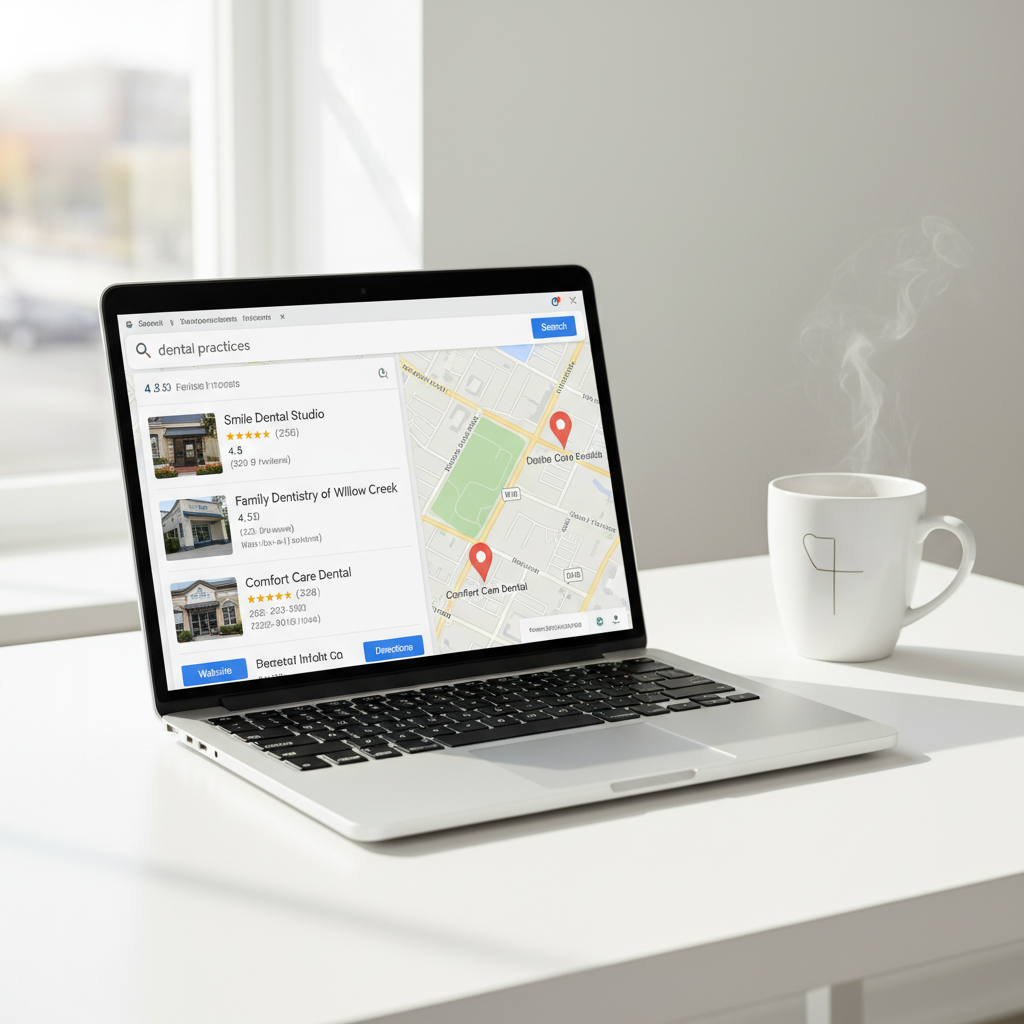
What Is the Google Maps 3-Pack?
The 3-Pack captures 42% of all clicks for local searches. Ranking here drives phone calls and bookings directly from search results, before patients even visit your website.
Optimize Your Google Business Profile
Complete every field, add 50+ photos, post weekly updates, respond to every review within 24 hours, and ensure identical NAP across all directories.
Google Business Profile: Your #1 Local Ranking Factor
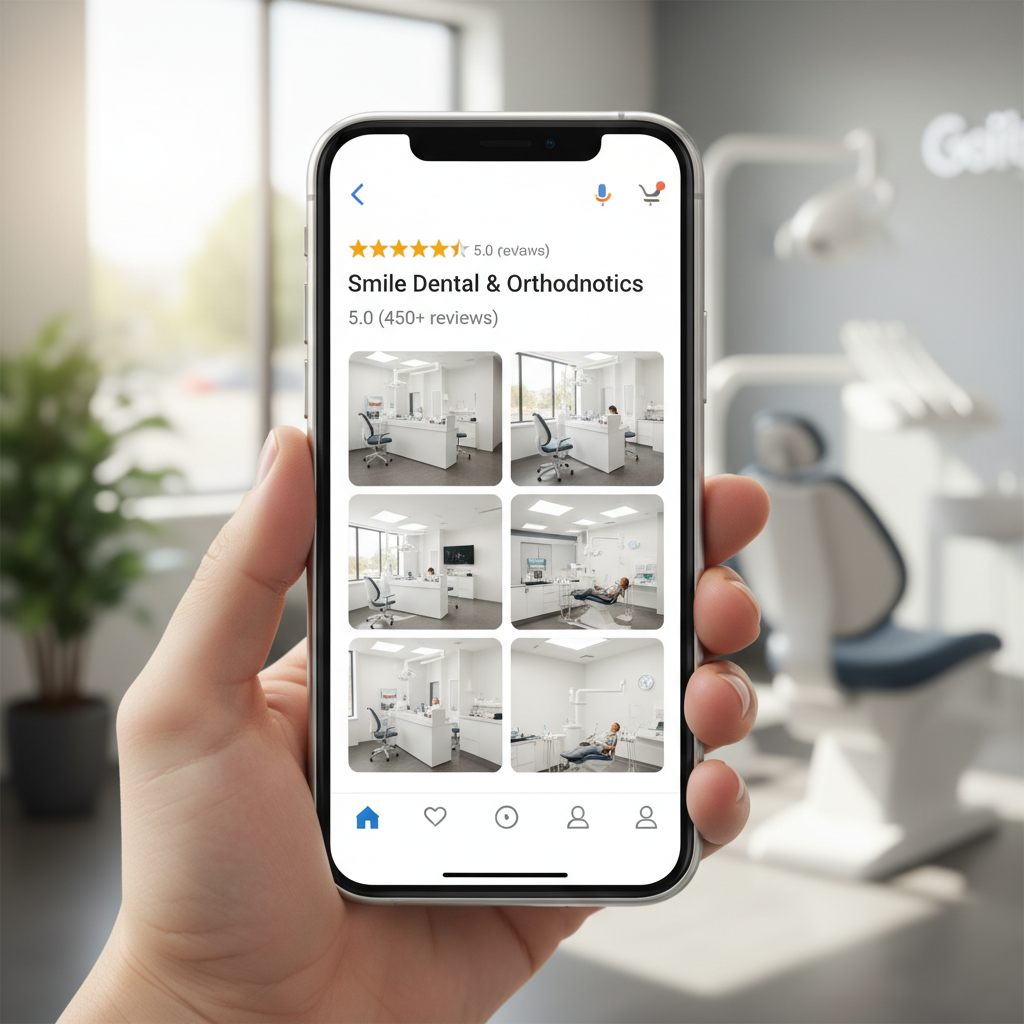
The Complete GBP Checklist
How Google Reviews Boost Dental SEO

Review Velocity Matters More Than Total Count
A practice getting 10 new reviews per month outranks one with 500 total reviews but only 1 new per month. Set up automated review requests after every appointment.
Responding to Negative Reviews
Respond to every review within 24 hours. For negatives: acknowledge, apologize without admitting fault, take it offline. Never argue publicly. Practices with 4.8+ ratings and 100+ reviews rank higher.
Dental SEO vs Google Ads: Which Is Better?

Use Both for Maximum Results
Ads deliver immediate calls. SEO builds free long-term traffic. CPC for "dentist near me" is $8-15, which adds up fast. Run paid advertising for immediate flow while SEO builds the foundation. Practices doing both outperform by 3-5x.
Procedure-Specific Dental SEO Strategies
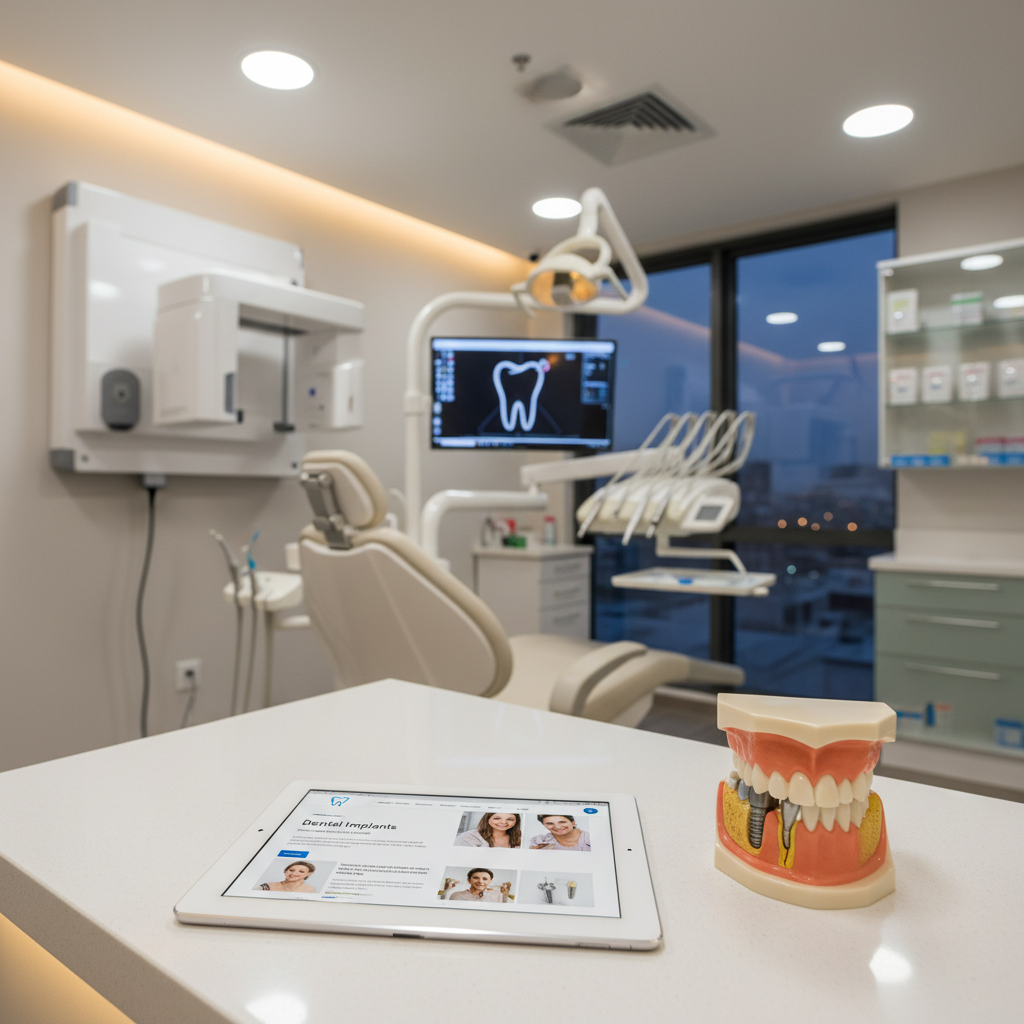
Dental Implant SEO: $20K+ Case Keywords
Target "dental implants [city]," "All-on-4 [city]," "how much do dental implants cost." Create dedicated pages with galleries, pricing, and testimonials. Learn more.
Cosmetic & Invisalign SEO
Cosmetic patients spend 2-3x longer on your site. Use stunning before/after galleries and video testimonials. Target "cosmetic dentist [city]" and "Invisalign [city]."
Emergency Dentistry SEO
Emergency keywords have the highest conversion rates. Target "emergency dentist [city]." Display your phone number and hours prominently. These patients call the first practice they find.
Top 5 Dental SEO Ranking Factors in 2026
Content Quality & E-E-A-T
Dentist-authored content, testimonials, credentials, and original photography.
Backlinks & Domain Authority
One link from a dental association beats 100 random directory links.
Core Web Vitals & Speed
Load under 3 seconds on mobile. Optimize images, use lazy loading.
Search Intent Alignment
Match content to what patients want. 'Dentist near me' needs a location page, not a blog.
Technical SEO & Crawlability
XML sitemaps, clean URLs, canonical tags, and schema markup on every page.
6 Technical SEO Elements Every Dental Site Needs

Not Sure Where Your SEO Stands?
Get a free dental SEO audit. No commitment required.
Dental SEO Content: What to Write

Service Pages That Rank
Every service needs 1,000+ words: procedure description, benefits, candidacy, process, recovery, cost, before/after photos, testimonials, and FAQ.
Blog Topics That Drive Traffic
Focus on patient questions: "How much do implants cost?", "Does Invisalign hurt?" Publish 2-4 posts/month. A 1,500-word article outperforms five 300-word posts.
Dental Link Building: Earn Backlinks That Rank

Best Link Building Strategies
Join dental associations, sponsor local events, write guest articles, get local news features, build relationships with complementary providers.
Local Citations & Directories
List on Healthgrades, Zocdoc, Vitals, WebMD, Yelp, BBB, and your Chamber of Commerce. Keep NAP identical everywhere.
6 Dental SEO Mistakes That Kill Rankings
Ignoring Local Intent
Target 'dentist in [city]' not 'best dentist.'
Weak/Duplicate Content
Generic content gets penalized. Write original, in-depth pages.
Missing Schema Markup
No schema = no rich snippets = lower click-through rates.
Poor Review Management
Not generating or responding to reviews hurts rankings.
Slow Mobile Speed
3+ seconds to load = 53% of visitors lost.
No Internal Linking
Link service pages, blogs, and locations together.
Track & Measure Dental SEO Results
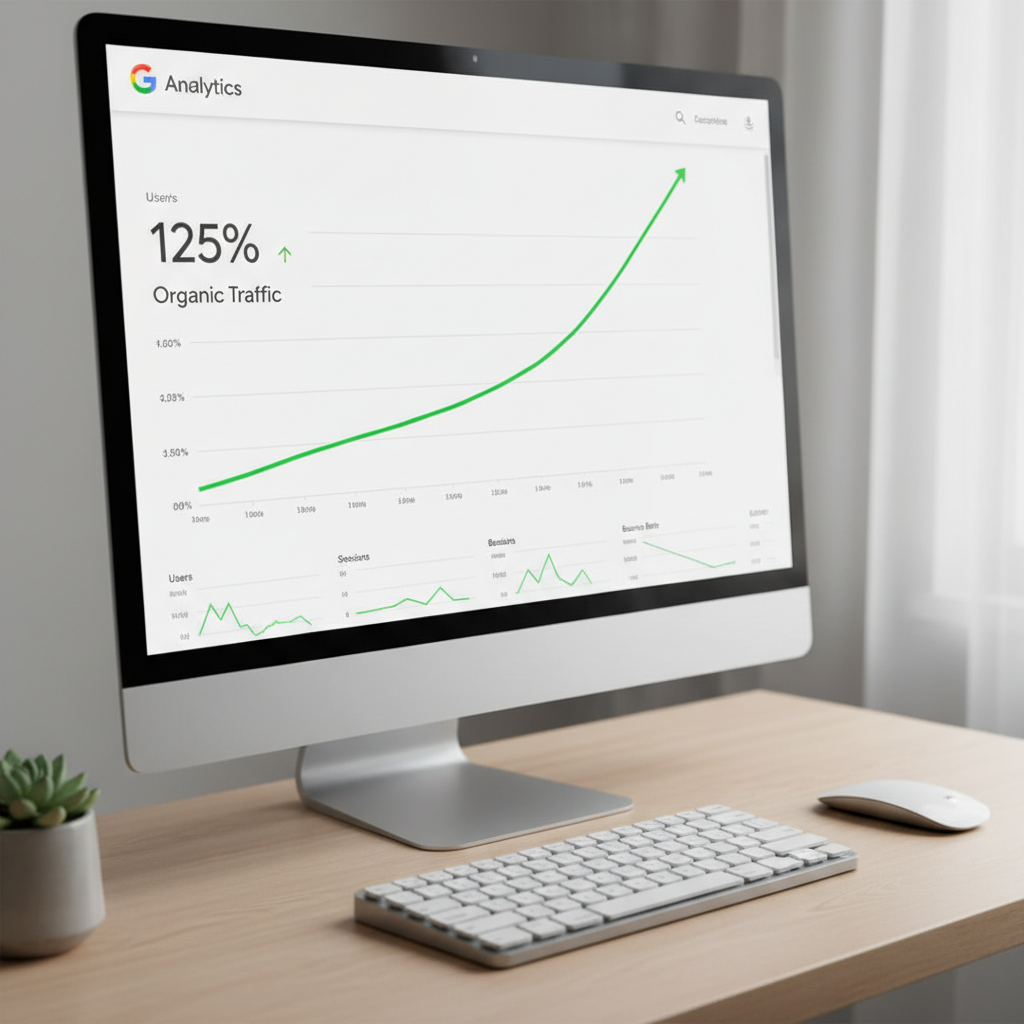
5 KPIs That Matter
Organic traffic, keyword rankings, GBP views/actions, new patient calls from search, and cost per acquisition. Use our ROI calculator.
Realistic 12-Month Growth
Months 1-3: Foundation, 10-20% traffic lift. Months 4-6: Local keywords moving, 30-50%. Months 7-9: Page 1 rankings, 50-100%. Months 10-12: Compounding, 100-200%+ increase.
Dental SEO Pricing
Multi-location? Contact us for custom pricing
Key Takeaways
Dental SEO Questions
Most dental practices see measurable improvements in 3-6 months. Local SEO improvements like Google Business Profile optimization can show results in 4-8 weeks.
Our dental SEO packages start at $1,000/month. For $1,500/month you get 2x the content volume. We guarantee you will rank #1 on Google within 6 months. Multi-location practices can inquire about custom pricing.
Both serve different purposes. Ads deliver immediate visibility, SEO builds long-term traffic. Practices that do both outperform those doing only one.
The map with three business listings at the top of Google for local searches like 'dentist near me.' It captures 42% of all local clicks.
Complete every field, add 50+ photos, post weekly updates, respond to every review within 24 hours, and ensure consistent NAP across all directories.
Yes, significantly. Reviews are a top 3 local ranking factor. Aim for 5-10 new reviews per month and respond to every single one.
Start with '[city] dentist,' 'dentist near me,' '[city] dental implants.' Then expand to procedure-specific and question-based content.
If you have 10-15 hours/month for DIY, basic local SEO is possible. Most practice owners find an agency delivers faster, more consistent results.
Ignoring local intent, weak content, missing schema markup, poor review management, slow page speed, and no internal linking strategy.
Backlinks are a top 3 ranking factor. One link from a dental association or local news site is worth more than 100 from irrelevant directories.
Ready to Rank #1?
Free dental SEO audit. See where you stand and the fastest path to page one.
How to Rank #1 on Google for Your Dental Practice
The complete dental SEO playbook: local rankings, Google Maps 3-Pack domination, content strategy, and the exact tactics used by 300+ dental practices to attract high-value patients from organic search.
What Is Dental SEO? A Definition for Practice Owners
Why Dental SEO Is the Highest-ROI Marketing Channel for Dentists
Dental SEO (Search Engine Optimization) is the process of optimizing your dental practice's online presence so you appear at the top of Google when potential patients search for dental services in your area. Unlike Google Ads where you pay for every click, organic SEO traffic is essentially free once you rank. This makes dental SEO the highest-ROI marketing channel available to dental practices, delivering 5-10x returns compared to traditional dental marketing methods.
How Google Decides Which Dental Practices Rank First
Google uses over 200 ranking factors, but for dental practices, the most important ones are: relevance (does your content match what the patient is searching for), authority (do other websites link to and reference your practice), and proximity (how close is your practice to the searcher). Understanding these three pillars is the foundation of every successful dental SEO strategy.
Local Dental SEO: How to Rank in the Google Maps 3-Pack
What Is the Google Maps 3-Pack and Why It Matters for Dental Practices
The Google Maps 3-Pack is the map with three business listings that appears at the top of search results when someone searches "dentist near me" or "dental implants [city]." It captures 42% of all clicks for local searches. Ranking in the 3-Pack is the single most valuable SEO outcome for dental practices because it drives phone calls and appointment bookings directly from the search results page, before the patient even visits your website.
How to Optimize Your Google Business Profile for Maximum Dental SEO Impact
Complete every field in your Google Business Profile: practice name, address, phone, hours, all dental services, and primary/secondary categories. Add 50+ high-quality photos of your office, team, and before/after results. Post weekly updates with dental tips and promotions. Respond to every review within 24 hours. Ensure your NAP (name, address, phone) is identical across every online directory and citation.
Google Business Profile Optimization: Your #1 Local Ranking Factor
The Complete Google Business Profile Checklist for Dental Practices
How Google Reviews Boost Dental SEO Rankings
Why Review Velocity Matters More Than Total Review Count
Google reviews are one of the top 3 local ranking factors. But it is not just about having lots of reviews. Google also measures review velocity, how frequently you receive new reviews. A practice getting 10 new reviews per month will outrank a practice with 500 total reviews but only 1 new review per month. Set up an automated review request system that sends patients a text or email after every appointment.
How to Respond to Negative Dental Reviews Without Hurting Your SEO
Respond to every review, positive or negative, within 24 hours. For negative reviews: acknowledge the concern, apologize for the experience (without admitting fault), take the conversation offline by providing a direct phone number. Never argue publicly. Google rewards businesses that actively engage with reviewers. Practices with a 4.8+ average rating and 100+ reviews consistently rank higher in the Map Pack for dental SEO keywords.
Dental SEO vs Google Ads: Which Is Better for Dentists?
Why the Best Dental Marketing Strategy Uses Both SEO and Paid Ads
Google Ads delivers immediate visibility: you can have new patient calls within 24 hours of launching a campaign. Dental SEO builds long-term organic traffic that compounds over time without per-click costs. The average cost-per-click for "dentist near me" is $8-15, which adds up fast. Meanwhile, organic traffic from dental SEO is essentially free once you rank. Our recommendation: run targeted paid advertising for immediate patient flow while SEO builds the long-term foundation. Practices that do both outperform those doing only one by 3-5x.
Procedure-Specific Dental SEO: Ranking for High-Value Services
Dental Implant SEO: Targeting $20K+ Case Keywords
Dental implant keywords are among the most valuable in dentistry, with patients searching for procedures worth $3,000-$50,000+. Target keywords like "dental implants [city]," "All-on-4 implants [city]," and "how much do dental implants cost." Create dedicated landing pages for each implant procedure with before/after galleries, pricing transparency, and patient testimonials. Learn more about our dental implant marketing strategies.
Cosmetic Dentistry and Invisalign SEO Strategies
Cosmetic dentistry patients are highly visual and research-driven. They spend 2-3x longer on your website than general dentistry patients. Your cosmetic and Invisalign pages need stunning before/after galleries, video testimonials, and detailed procedure information. Target keywords like "cosmetic dentist [city]," "veneers [city]," "Invisalign [city]," and "smile makeover near me."
Emergency Dentistry SEO: Capturing Urgent Patient Searches
Emergency dental keywords have extremely high conversion rates because patients need help immediately. Target "emergency dentist [city]," "same-day dental appointment," and "dentist open Saturday near me." Your emergency page must prominently display your phone number, hours, and a clear "Call Now" button. These patients will call the first practice they find, so ranking #1 matters even more for emergency dental SEO.
Top 5 Dental SEO Ranking Factors Google Uses in 2026
Content Quality and E-E-A-T Signals
Google prioritizes content that demonstrates Experience, Expertise, Authoritativeness, and Trustworthiness. For dental websites, this means having dentist-authored content, patient testimonials, credentials displayed, and original clinical photography.
Backlinks and Domain Authority for Dental Websites
Quality backlinks from dental associations, local news sites, health directories, and community organizations signal to Google that your practice is a trusted authority. One link from your state dental association is worth more than 100 links from random directories.
Core Web Vitals and Mobile Page Speed
Google measures your page loading speed, visual stability, and interactivity. Dental websites must load in under 3 seconds on mobile. Optimize images, use lazy loading, and ensure your site is fully responsive on all devices.
Search Intent Alignment for Dental Keywords
Your content must match what patients actually want when they search. 'Dentist near me' requires a location-focused page. 'How much do dental implants cost' requires an educational article. Mismatched intent kills rankings regardless of other optimizations.
Technical SEO and Crawlability for Dental Websites
Ensure Google can crawl and index every important page on your site. This means proper XML sitemaps, clean URL structures, no duplicate content, correct canonical tags, and schema markup on every service page.
6 Critical Technical SEO Elements Every Dental Website Needs
Title Tags Optimized for Dental Keywords
Every page needs a unique title tag under 60 characters containing your target keyword and city. Example: 'Dental Implants Atlanta | [Practice Name]'
Meta Descriptions That Drive Clicks from Search Results
Write compelling 150-160 character descriptions that include your keyword, a benefit, and a call to action. This directly affects your click-through rate from Google.
Schema Markup for Dental Practices
Add LocalBusiness, Dentist, and MedicalOrganization schema markup. This enables rich snippets showing your rating, hours, and services directly in search results.
Internal Linking Strategy Between Dental Service Pages
Link your service pages, blog posts, and location pages together with keyword-rich anchor text. This distributes ranking authority across your entire site.
Mobile-First Design for Dental Websites
Google uses mobile-first indexing. If your dental website does not work perfectly on smartphones, you will not rank. Period. A professional dental website must be mobile-optimized.
Page Speed Optimization for Core Web Vitals
Compress images to WebP format, enable lazy loading, minimize JavaScript, and use a CDN. Dental websites should score 90+ on Google PageSpeed Insights.
Not Sure Where Your Dental SEO Stands?
Get a free dental SEO audit that shows exactly where you rank, what your competitors are doing, and the fastest path to page one. No commitment required.
Dental SEO Content Strategy: What to Write and Where to Publish
How to Structure Dental Service Pages That Rank on Google
Every dental service needs its own dedicated page with 1,000+ words of unique content. Include: procedure description, benefits, candidacy criteria, process overview, recovery timeline, cost/financing information, before/after photos, patient testimonials, and an FAQ section. This depth signals expertise to Google and answers every question a patient might have before calling.
Dental Blog Topics That Actually Drive Organic Search Traffic
Focus on question-based content that patients are actively searching for: "How much do dental implants cost in [city]?", "Does Invisalign hurt?", "What to expect during a root canal." Use Google's "People Also Ask" feature to find related questions for each topic. Publish 2-4 blog posts per month, each targeting a specific long-tail keyword. Quality matters more than quantity, so a well-researched 1,500-word article outperforms five 300-word posts.
Dental Link Building: How to Earn Backlinks That Boost Rankings
The Best Link Building Strategies for Dental Practices in 2026
Quality backlinks remain one of Google's top 3 ranking factors. For dental practices, focus on: joining your state and local dental associations (they link to member directories), sponsoring local community events, writing guest articles for health and wellness blogs, getting featured in local news publications, and building relationships with complementary local businesses (orthodontists, oral surgeons, pediatricians) for cross-referrals and links.
Local Citations and Directory Listings That Impact Dental SEO
Ensure your practice is listed on the top 50 dental and healthcare directories: Healthgrades, Zocdoc, Vitals, WebMD, Yelp, Better Business Bureau, and your local Chamber of Commerce. Your NAP (name, address, phone) must be identical on every listing. Inconsistent information confuses Google and can hurt your local rankings significantly.
6 Costly Dental SEO Mistakes That Kill Your Google Rankings
Ignoring Local Search Intent
Targeting broad national keywords like 'best dentist' instead of local terms like 'dentist in [your city].' Local intent keywords convert 5-10x better because patients are looking for nearby providers.
Publishing Weak or Duplicate Dental Content
Using generic content that could describe any dental practice, or worse, copying content from other websites. Google penalizes duplicate content and rewards original, in-depth dental content that demonstrates real clinical expertise.
Missing Schema Markup on Dental Service Pages
Without schema markup, Google cannot display rich snippets (star ratings, hours, services) in search results. This means lower click-through rates even if you rank on page one. Every dental service page needs LocalBusiness and MedicalOrganization schema.
Poor Google Review Management and Response
Not actively generating new reviews or failing to respond to existing ones. Google factors review quantity, quality, velocity, and owner responses into local rankings. Ignoring reviews sends a negative signal.
Slow Mobile Page Speed on Your Dental Website
A dental website that takes more than 3 seconds to load on mobile loses 53% of visitors. Google uses page speed as a direct ranking factor. Optimize images, minimize code, and use a fast hosting provider.
No Internal Linking Strategy Between Pages
Failing to connect your dental service pages, blog posts, and location pages with keyword-rich internal links. Internal links distribute ranking authority and help Google understand your site structure. Every page should link to at least 3-5 other relevant pages.
How to Track and Measure Dental SEO Results
The 5 Dental SEO KPIs That Actually Matter
Track these five metrics monthly: organic search traffic (Google Analytics), keyword rankings for your top 20 target terms, Google Business Profile views and actions, new patient calls from organic search (call tracking), and cost per patient acquisition from SEO versus paid channels. If you are not tracking these, you are flying blind. Use our dental ROI calculator to model your expected returns.
What Realistic Dental SEO Growth Looks Like Over 12 Months
Months 1-3: Foundation work (technical fixes, GBP optimization, content creation). Expect 10-20% traffic increase. Months 4-6: Rankings start moving for local keywords. 30-50% traffic increase. Months 7-9: Competitive keywords begin ranking page 1-2. 50-100% traffic increase. Months 10-12: Compounding effects. 100-200%+ traffic increase with significant new patient volume from organic search.
How Much Does Dental SEO Cost? Transparent Pricing
Multi-location practice? Contact us for custom multi-location pricing | View all packages
Key Takeaways: How to Rank #1 on Google for Dentists
Common Questions About Dental SEO Services and Rankings
Most dental practices see measurable improvements in 3-6 months. Local SEO improvements like Google Business Profile optimization can show results in 4-8 weeks. Competitive keywords like 'dental implants' or 'cosmetic dentist' typically take 6-12 months to reach page one. Consistent effort over 12+ months delivers compounding returns.
Our dental SEO packages start at $1,000/month, which includes on-page optimization, Google Business Profile management, blog content, local citations, and ranking reports. For $1,500/month you get 2x the content volume plus advanced keyword targeting and strategy calls. We guarantee you will rank #1 on Google within 6 months. Multi-location dental practices can inquire about custom pricing for location-specific SEO strategies.
Both serve different purposes. Google Ads delivers immediate visibility and new patient calls within days. SEO builds long-term organic traffic that compounds over time without per-click costs. The best strategy is to run both simultaneously: ads for immediate patient flow while SEO builds the long-term foundation. Practices that do both outperform those that do only one.
The Google Maps 3-Pack (or Local Pack) is the map with three business listings that appears at the top of Google search results for local queries like 'dentist near me.' It captures 42% of all clicks for local searches. Ranking in the 3-Pack is the single most valuable SEO outcome for dental practices because it drives phone calls and appointment bookings directly from the search results page.
Complete every field: business name, address, phone, hours, services, and categories. Add 50+ high-quality photos of your office, team, and before/after results. Post weekly Google Business Profile updates. Respond to every review within 24 hours. Add all dental services as Products. Use the Q&A feature to answer common patient questions. Ensure your NAP (name, address, phone) is consistent across all online directories.
Yes, significantly. Google reviews are one of the top 3 local ranking factors. Practices with 100+ reviews and a 4.8+ average rating rank significantly higher in the Map Pack than those with fewer reviews. Review velocity (how frequently you receive new reviews) also matters. Aim for 5-10 new reviews per month and respond to every single one, positive or negative.
Start with high-intent local keywords: '[city] dentist,' 'dentist near me,' '[city] dental implants,' and '[city] emergency dentist.' Then expand to procedure-specific terms: 'All-on-4 dental implants [city],' 'Invisalign [city],' 'teeth whitening [city].' Finally, add informational content targeting questions like 'how much do dental implants cost' and 'does Invisalign hurt.'
If you have the time to learn SEO and implement it consistently (10-15 hours/month minimum), DIY is possible for basic local SEO. However, most dental practice owners find that their time is better spent on patient care. A specialized dental SEO agency brings industry-specific knowledge, established processes, and dedicated resources that typically deliver faster and more consistent results.
The six most costly mistakes are: ignoring local search intent (targeting national keywords instead of local), publishing weak or duplicate content, missing schema markup on service pages, poor review management (not responding or not generating new reviews), slow page speed (especially on mobile), and having no internal linking strategy connecting your service pages, blog posts, and location pages.
Backlinks remain one of Google's top 3 ranking factors. For dental practices, quality matters more than quantity. One link from a local news site, dental association, or health directory is worth more than 100 links from irrelevant websites. Focus on earning links through community involvement, dental association memberships, guest articles on health blogs, and partnerships with local businesses.
Ready to Rank #1 on Google for Your Dental Practice?
Get a free dental SEO audit that reveals exactly where you stand, what your competitors are doing right, and the fastest path to page one. See our case studies to learn how we help dental practices dominate Google search results.