




A person at home asking a voice assistant on a phone for a dentist recommendation, illustrating AI search for dental care
Dental AI-Search GEO Checklist

Your Next Patient Is Asking ChatGPT: The Dental AI-Search (GEO) Checklist

Patients no longer just type a dentist into a search box. They ask ChatGPT, Gemini, and Google AI to recommend one, and the AI names a practice. This is the generative engine optimization checklist that gets your practice cited in those answers instead of skipped.

1 answer
AI tools return one synthesized recommendation, not ten blue links to choose from
Top of page
Google AI Overviews now appear above the first practice website on many health searches
Source: Google Search docs
3 engines
ChatGPT, Gemini, and Perplexity are now common first stops for local recommendations
Cited or skipped
an AI either names your practice or it does not. There is no second page to land on
Source: CMC analysis
Blake Hundley, Founder of Closing More Cases
Written by Blake Hundley
Founder, Closing More Cases. Blake helps dental practices across the United States get found by the patients searching for them, including the growing share who now ask ChatGPT, Gemini, and Google AI for a dentist. His team builds the search and AI-visibility systems described in this checklist for practices nationwide.
Published June 23, 2026 | Last updated June 2026
The Shift

Your Next Patient Is Asking an AI, Not Just a Search Box

For two decades, getting found meant ranking in a list of blue links. A patient typed "dentist near me," saw ten options, and clicked. That world is quietly being replaced. A growing share of people now open ChatGPT, Gemini, or Perplexity and simply ask, "Who is a good dentist near me for an anxious patient?" or "Compare the two implant practices in my town." The tool reads the web for them and hands back a short, confident answer that names one or two practices. There is no list to scroll. There is an answer, and your practice is either in it or it is not.

Even Google Search Now Answers Before It Lists

This is not only about standalone chatbots. Google now shows AI Overviews at the top of many searches, including health and local queries, synthesizing an answer from across the web before a single practice website appears. According to Google Search documentation on AI features, these experiences pull from and link to sources the system judges to be helpful and reliable. The patient often reads the AI summary and acts on it without ever scrolling to the classic results. If your practice is not part of what that summary draws from, you have lost the patient at the very top of the page.

Why Dentistry Is Especially Exposed to This Change

Choosing a dentist is a high-trust, local decision, and those are exactly the questions people are most eager to hand to an AI. A nervous patient wants reassurance. A parent wants someone gentle with kids. A patient facing implants wants to compare a few options without visiting six websites. AI tools feel like a knowledgeable friend who has already done the research. That convenience is why this behavior is spreading fastest in exactly the kind of considered, personal decisions that fill a dental chair. The practices that adapt their dental SEO foundation for this new reality will be the ones these tools recommend.

How It Works

How AI Answer Engines Decide Which Dentists to Name

An answer engine does not pick a dentist out of thin air. It assembles a response from sources it can find, understand, and trust, then synthesizes them into a recommendation. Understanding that process tells you exactly what to optimize.

Trust, Clarity, and Consistency Win

When a model builds an answer, it leans toward practices it can describe with confidence. That confidence comes from a few repeating signals: your business facts appear identically across the web, a steady stream of genuine reviews backs up your quality, your website clearly states who you are and what you do, and respected third parties mention you. Each consistent signal makes the model more sure it will not embarrass itself by naming you. Ambiguity is the enemy. A practice with conflicting addresses, thin reviews, and a vague website is one the model quietly leaves out, because it cannot vouch for you.

It Quotes What Is Easy to Quote

Answer engines prefer sources that have already done the work of stating a clear, self-contained fact. A page that directly answers "How much do dental implants cost in Atlanta?" in its first two sentences is far easier to cite than one that buries the answer in paragraph nine. The same is true of your services, your hours, and your specialties. The more cleanly your site states the facts a patient is asking about, the more often an engine will lift those facts and credit your practice as the source.

Hands typing on a laptop while using an AI chat tool to research and compare local dentists
GEO vs SEO

GEO vs SEO: Why Classic SEO Is Necessary but Not Enough

It is tempting to treat GEO as a brand-new game that replaces SEO. It is not. Generative engine optimization sits on top of search engine optimization. The AI tools crawl and lean on the same web your classic SEO already shapes. If your foundation is weak, you will be invisible in both. The distinction is what you add once that foundation is in place.

What SEO and GEO Share

Both reward a fast, crawlable website, a complete and active Google Business Profile, a deep base of recent reviews, and genuine authority earned over time. There is no shortcut around these. A practice that ignored its ranking on Google for years will not suddenly appear in ChatGPT because it added a few lines of code. The trust signals are shared, which is good news: most of the work that earns AI citations also lifts your classic rankings.

What GEO Adds on Top

GEO adds a focus on being machine-readable and quotable. That means richer structured data so engines never have to guess your facts, ruthless entity consistency so your practice is understood as one clear business, content written in a question-and-answer shape that an AI can lift as a clean passage, and a deliberate effort to be mentioned and cited by third parties the engines already trust. SEO asks, "Can a person find and click my page?" GEO asks, "Can a machine confidently describe and recommend my practice without me there to explain it?" You need both questions answered yes.

The Checklist

The Dental GEO Checklist: 7 Things to Get Right

This is the core of the playbook. Work through these seven items in order. The earlier ones are foundations the later ones build on, and together they form the complete picture an AI engine needs to confidently recommend your practice. The next sections then go deeper on the three that move the needle most.

1

Lock Down Your Structured Data

Mark up your practice with Dentist or LocalBusiness schema covering name, address, phone, hours, and services, plus FAQPage schema on your common-question content. This labels every fact about your practice in a language machines read without ambiguity, which is the first thing an engine needs before it will name you.

2

Make Your Business Facts Identical Everywhere

Audit your name, address, and phone across your website, Google Business Profile, Yelp, healthcare directories, and social profiles. Fix every inconsistency. Engines combine these mentions into one understanding of your practice, and conflicting details make them less sure who you are and less likely to recommend you.

3

Build Review Depth and Recency, Not Just a Star Rating

Install a steady habit of earning recent, detailed reviews that mention specific services and outcomes. Depth and freshness give an AI concrete, quotable evidence of quality. A handful of old reviews gives it almost nothing to work with when it decides whom to trust.

4

Get Cited by Third Parties the Engines Trust

Earn mentions on reputable directories, local press, professional associations, and review platforms. AI engines weigh what others say about you, not only what you say about yourself. Off-site citations are some of the strongest evidence that your practice is real, established, and worth naming.

5

Write Answer-Shaped Content

Turn the real questions patients ask into headings, then answer each directly in the first two or three sentences before adding detail. This is the same format that earns featured snippets, and it gives an AI a clean, self-contained passage it can quote and credit to your practice.

6

Keep Authoritative Content Fresh

Update key pages and publish new, genuinely useful content on a regular cadence. Freshness and ongoing expertise signal that your practice is active and current, which engines favor when choosing a recommendation a patient will act on today.

7

Make Your Site Easy for AI Crawlers to Read

Ensure your pages load fast, render their content without requiring scripts to see the words, and do not block the crawlers these tools rely on. If an engine cannot cleanly read your page, it cannot cite it, no matter how good the content is.

Practices that want this built and maintained for them use done-for-you SEO services so every item on this checklist stays handled while they focus on dentistry. The next three sections unpack the highest-leverage items in detail.

Want to Know If AI Tools Recommend Your Practice Today?

Get a free AI-visibility audit. We test how ChatGPT, Gemini, and Google AI describe your practice, check your structured data and listing consistency, and show you the highest-leverage fixes to start earning AI citations first.

Structured Data

Structured Data: Speaking the Language of Machines

A human can read your homepage and understand you are a family dentist in Atlanta open until six on Thursdays. A machine has to infer it, unless you tell it plainly. Structured data is how you tell it plainly, removing the guesswork that keeps engines from confidently naming you.

The Schema a Dental Practice Should Add

Start with Dentist or LocalBusiness schema that states your name, address, phone, hours, geographic area served, and the services you offer. Add FAQPage schema to any page that answers common patient questions, so engines can lift those answers cleanly. Where you have genuinely earned reviews and it is policy-compliant, structured review data can reinforce trust. Each piece of markup turns a fact a machine would otherwise have to guess into a fact it can read with certainty.

Why It Lifts Citations, Not Just Rankings

Structured data does not magically force an engine to name you. What it does is eliminate ambiguity, and ambiguity is the single biggest reason a model leaves a practice out of an answer. When every important fact about your practice is labeled and consistent, the model can describe you accurately without fear of being wrong, which is exactly the confidence it needs to recommend you. Combine clean markup with a solid dental SEO foundation and you become one of the easiest practices in your area for an AI to cite.

Abstract glowing network of connected nodes representing structured data that AI engines read about a dental practice
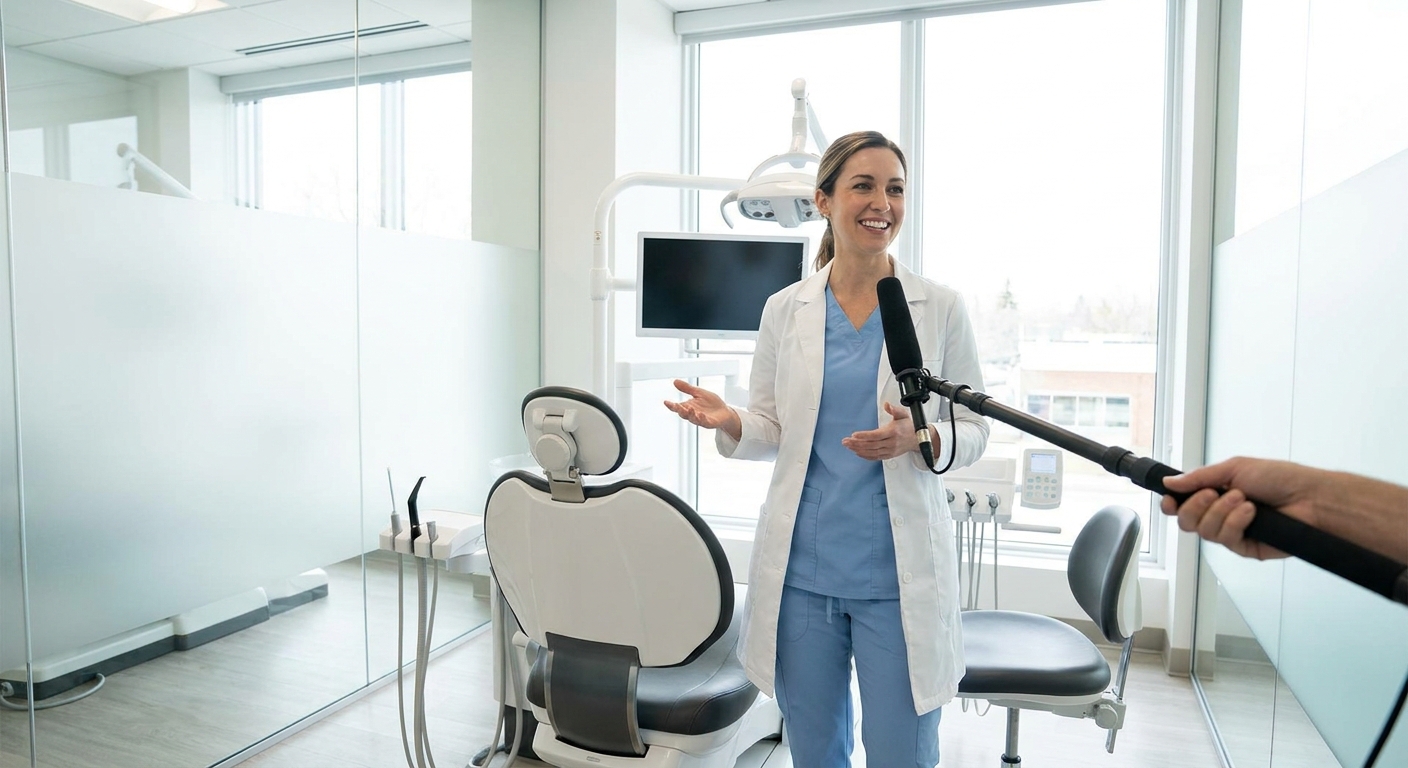
A confident dentist being interviewed in a modern office, building third-party authority that AI engines cite
Entity Consistency

Entity Consistency: Be the Same Practice Everywhere

AI engines build a mental model of your practice by stitching together every mention of it across the web. If those mentions disagree, the model gets confused about who you are. Entity consistency is the quiet, unglamorous work that makes you legible to a machine, and it is one of the highest-leverage moves most practices have never done.

What Consistency Actually Means

Your practice name, address, and phone number should appear character-for-character identical on your website, your Google Business Profile, Yelp, healthcare directories, your social profiles, and anywhere else you are listed. Even small differences, an abbreviated street name here, an old suite number there, a second phone line that no longer rings, chip away at an engine's confidence that all these listings describe one real, trustworthy business.

How to Clean It Up and Keep It Clean

Start with an audit of every place your practice appears, then correct each one to a single source of truth. Decide once how your name, address, and phone are written, and enforce it everywhere. Reputable organizations like the American Dental Association maintain directories where an accurate listing adds a trusted, consistent mention. From there, make listing hygiene a recurring task, because details drift over time. A consistent entity is one an AI can describe without hesitation, and hesitation is what keeps you out of the answer.

Third-Party Citations

Third-Party Citations: Getting Mentioned Off Your Own Site

Everything you say about your own practice is, to a skeptical machine, marketing. What others say about you carries far more weight. AI engines treat independent mentions as corroboration, and the more trusted sources that describe your practice consistently, the more confident an engine is in naming you. These are the citation sources worth pursuing.

Authoritative directories: professional associations, healthcare directories, and well-known local business listings that confirm who and where you are.
Review platforms: deep, recent reviews on Google, Yelp, and healthcare-specific sites that give engines quotable evidence of patient experience.
Local press and community sites: features, sponsorships, and mentions that tie your practice to a real place and a real community.
Industry publications: being quoted or featured in dental and small-business media that engines already treat as expert sources.
Partner and referral pages: mentions from specialists, labs, and local businesses you genuinely work with.

The pattern that earns AI citations is the same one that builds real-world reputation: be genuinely present, helpful, and consistent everywhere your community already looks. You can audit how your practice is described off-site and where the gaps are with a dedicated SEO services review, then close those gaps deliberately rather than hoping the mentions appear on their own.

A young patient smiling at a phone after an AI tool recommended a trusted local dental practice
Answer-Shaped Content

Answer-Shaped Content: Writing for the Way People Ask

Most dental websites are written to sound good to a human scrolling slowly. AI engines reward something slightly different: content shaped like an answer, where the question is asked plainly and the answer is delivered immediately. Get this right and your pages become the clean, quotable passages engines reach for. It also wins you featured snippets in classic search, so the effort pays off twice.

Lead With the Answer, Then Add the Depth

Use the real question your patient would type or speak as a heading, then answer it directly in the first two or three sentences. "Does a root canal hurt?" should be followed immediately by a clear, honest answer, not three paragraphs of throat-clearing. Once the direct answer is in place, you can add the nuance, the exceptions, and the detail a curious patient wants. An engine can lift that opening as a complete thought and credit your practice, while the reader who keeps scrolling still gets the full picture.

Cover the Questions Patients Actually Ask Next

Real patient curiosity moves in chains. Someone who asks about implant cost next wants to know about financing, recovery, and how long implants last. Map those follow-up questions and answer each one in its own clearly labeled section. This breadth signals genuine expertise and gives an engine many clean passages to draw from, raising the odds it cites you across a whole cluster of related queries. For inspiration on the questions to target, our AI prompts for dentists and our Google Business Profile audit prompts help you surface exactly what patients are asking and shape content to match. Industry resources like Dental Economics can also point you to the practice-marketing topics patients care about most.

Measuring AI Visibility

How to Measure Your AI Visibility

AI visibility is harder to measure than a classic ranking, but it is far from invisible. You watch a handful of signals as a trend over months rather than a single number you check each morning. These four are the most useful for a dental practice.

Direct AI Mentions

Periodically ask ChatGPT, Gemini, and Perplexity the questions your patients ask, like 'best family dentist in [city],' and note whether your practice is named or cited.

Goal: Named in the answer
AI Overview Presence

Watch whether your practice or content appears or is linked inside Google AI Overviews for your priority local and service queries.

Goal: Cited above the fold
AI Referral Traffic

Monitor your analytics for visits originating from AI tools and assistants. A rising trickle signals your content is being surfaced and clicked.

Goal: Steady upward trend
Brand Mention and Review Momentum

Track new third-party mentions and the recency and depth of your reviews. These feed AI confidence, so growth here predicts more citations.

Goal: Growing month over month
A forward-thinking dentist standing confidently in a sleek modern clinic, ahead of competitors on AI search
Act Now

Why Acting Now Puts Your Practice Ahead

Most dentists have not heard of generative engine optimization, let alone started on it. That is the opportunity. AI visibility compounds on trust signals that take time to build, so the practice that begins today is laying a foundation competitors cannot match overnight when they finally notice the shift.

Early Movers Become the Default Answer

When an engine has only one or two clearly described, well-reviewed, consistently listed practices to choose from in your area, it names them again and again. That position is self reinforcing: being cited drives clicks and patients, which drives more reviews and mentions, which makes the engine even more confident in you. The practice that gets there first tends to stay there.

The Work Pays Off in Both Worlds

Here is the reassuring part: almost everything on this checklist also strengthens your classic search rankings, your Google Business Profile, and your reputation. You are not betting on a single tool. You are building the kind of trustworthy, clearly described, well-reviewed practice that wins no matter how a patient searches. To see how that foundation changes results for real practices, review our practice growth case studies and start with a visibility audit of where you stand today.

Key Takeaways: The Dental AI-Search GEO Checklist

Patients increasingly ask ChatGPT, Gemini, Perplexity, and Google AI for a dentist, and the AI returns one synthesized answer that either names your practice or skips it.
GEO, generative engine optimization, is the work of becoming the practice those AI tools confidently recommend, by being clearly described, consistent, well-reviewed, and quotable.
Classic SEO is necessary but not sufficient. AI engines lean on the same trust signals, so a weak foundation stays invisible in AI answers too.
Lock down structured data so machines read your facts without guessing, the first thing an engine needs before it will name you.
Make your name, address, and phone identical everywhere. Entity consistency is one of the highest-leverage GEO moves and most practices skip it.
Build review depth and recency, and earn third-party citations from trusted directories, press, and platforms, because what others say about you carries the most weight.
Write answer-shaped content: ask the real question as a heading, answer it in the first sentences, then add depth, which earns both AI citations and featured snippets.
Start now. AI visibility compounds on trust signals that take time to build, so early movers tend to become and stay the default answer in their area.
Frequently Asked Questions

Common Questions About Dental AI Search and GEO

Generative engine optimization, or GEO, is the practice of making your dental practice the answer that AI tools like ChatGPT, Gemini, Perplexity, and Google AI Overviews recommend when someone asks for a dentist. Traditional SEO aims to rank your page in a list of blue links. GEO aims to get your practice named, quoted, and cited inside the synthesized answer the AI gives back. The two overlap, but GEO adds a focus on being the trusted, machine-readable source an answer engine pulls from.

A fast-growing share of people now start health and local searches inside AI tools instead of a search box. They ask questions like 'who is the best implant dentist near me,' 'is this dentist good with anxious patients,' or 'compare two practices in my town.' Younger patients in particular treat ChatGPT and Gemini as a first stop. Even patients who still use Google increasingly see an AI Overview at the top of the page before any practice website. If your practice is invisible to those systems, you are invisible at the exact moment of decision.

They synthesize an answer from sources they trust and can clearly understand. In practice that means they favor practices with consistent name, address, and phone details across the web, a deep and recent set of genuine reviews, clear structured data describing the business and its services, content written in a question-and-answer shape they can lift directly, and third-party mentions on directories, local press, and review platforms. The more clearly and consistently your practice is described everywhere, the easier you are to cite.

Yes. Classic SEO is necessary but no longer sufficient. AI engines crawl and lean on the same signals that power traditional search, your website, your Google Business Profile, your reviews, and your authority. A practice with weak SEO foundations rarely shows up in AI answers either. GEO builds on top of solid SEO by adding structured data, entity consistency, answer-shaped content, and off-site citations. Skipping the SEO foundation and chasing only AI tricks does not work.

At minimum, mark up your practice with Dentist or LocalBusiness schema including your name, address, phone, hours, and accepted services. Add FAQPage schema to your common-question content so engines can lift clean answers, and Review or aggregate markup only where it is genuinely earned and policy-compliant. Structured data does not guarantee a citation, but it removes ambiguity, which is exactly what an AI needs to confidently name you. Think of it as labeling every fact about your practice in a language machines read perfectly.

Entity consistency means your practice is described as the same single business everywhere it appears: identical name, address, phone, and key facts on your website, Google Business Profile, Yelp, healthcare directories, and social profiles. AI engines build an internal understanding of your practice by combining these mentions. When the details conflict, the engine becomes less confident about who you are and less likely to recommend you. Cleaning up inconsistent listings is one of the highest-leverage GEO moves a dental practice can make.

Strongly. Reviews are one of the clearest trust signals an answer engine can read, and depth and recency matter as much as the star rating. A practice with a steady stream of recent, detailed reviews that mention specific services and outcomes gives an AI concrete, quotable evidence of quality. A practice with a handful of old reviews gives it almost nothing to work with. A consistent review-generation habit feeds both your local search ranking and your AI visibility at the same time.

Answer-shaped content is written the way people actually ask questions and the way engines like to quote. Use the real question as a heading, then answer it directly in the first two or three sentences before adding detail. Cover the specific sub-questions a patient would ask next. Keep claims clear, factual, and easy to lift as a standalone passage. This is the same answer-first format that earns featured snippets in classic search, and it is exactly what an AI needs to cite a clean, self-contained answer from your page.

Yes, though it is less precise than classic rankings. Periodically ask the major tools, ChatGPT, Gemini, and Perplexity, the questions your patients ask, such as 'best family dentist in [your city],' and note whether your practice is named or cited. Watch for referral traffic from AI sources in your analytics, monitor brand mentions across the web, and track your Google Business Profile and review momentum. Treat it as a trend you watch over months, not a single number you check daily.

It depends on your starting point. Practices with strong existing SEO, a clean Google Business Profile, and a healthy review base can start appearing in AI answers within weeks of tightening structured data, entity consistency, and answer-shaped content. Practices starting from a weak foundation should expect a few months, because GEO compounds on top of the same authority and trust signals that take time to build. The earlier you start, the larger your head start before competitors catch on.

It is a lasting shift in how people find local businesses, including dentists. The specific tools will change, but the underlying behavior, asking a machine for a recommendation and trusting the synthesized answer, is already mainstream and growing. Practices that build clean, consistent, well-structured, well-reviewed online presences are positioned to win regardless of which AI tool a patient happens to use. The fundamentals of GEO reward exactly the kind of trustworthy, clearly described practice that good marketing has always aimed for.

You can have it built and managed for you. Closing More Cases combines a strong dental SEO foundation with the structured data, entity cleanup, review systems, and answer-shaped content that earn AI citations. You can review real dental practice results on the case studies page and request a free visibility audit that shows exactly where your practice stands in both classic search and AI answers today, and what to fix first.

Ready to Be the Dentist AI Recommends?

Get a free AI-visibility audit for your dental practice. We test how ChatGPT, Gemini, and Google AI describe you today, check your structured data, listing consistency, and reviews, then show you what to fix first to start earning citations. See our case studies to learn how a strong search and AI foundation changed the numbers for real practices.